|
1
|
|
|
2
|
- The usual definition of energy: the ability to do work
- Work is moving an object against an opposing force
- Work = distance × opposing force [ w = d x f ]
- SI unit of work or energy: the joule (J)
|
|
3
|
- A joule is the mechanical equivalent of heat meaning the number of units
of work which the unit of heat can perform.
- Its value was found by James Prescott Joule in experiments that showed
the mechanical energy which must be expended to raise the temperature of
a unit weight of water by 1 degree F. was equivalent to 772 foot-pounds
upon the Fahrenheit, thermometric scale, by reason of which it is often
called Joule's equivalent, and represented by the symbol J.
|
|
4
|
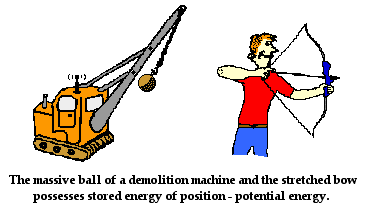
- Potential Energy: energy of position
- Examples
- Boulder on a ledge
- Cations and anions
- Chemical bonds
- Tell how each of the examples above have potential energy.
|
|
5
|
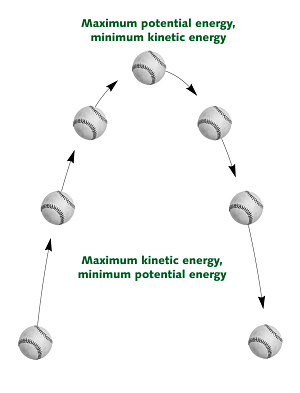
- Kinetic Energy: energy of motion. It depends on the mass and velocity
of the object. KE = ½ mv2
- (where m = mass and
- v = velocity)
- Examples
- Pool balls
- Molecules
- How do each of these have kinetic energy?
|
|
6
|
|
|
7
|
- Chemical Energy - stored energy that depends on the composition of the
substance.
- Nuclear Energy - energy involved in nuclear reactions.
- Electrical Energy - the chemical reaction that occurs in the battery of
a car produces electrical energy used to start the car and operate the
headlights, radio, etc.
|
|
8
|
- Light Energy - plants use the radiant energy of sunlight to do the work
of making carbon dioxide and water into sugar. This process of creating
stored chemical energy is photosynthesis.
- Mechanical energy – used to do mechanical work
- Sound Energy
- Thermal Energy – heat
- Two things energy is NOT
- Some sort of invisible fluid
- Something which can be measured directly
|
|
9
|
- Energy can be converted from one form to another form which is more
useful.
- This occurs all around you on a daily basis. Example: Consider when
electrical energy is converted into heat energy in a hair dryer.
- Give another example of energy conversion
|
|
10
|
- A fundamental law governs these energy conversions:
|
|
11
|
- in any chemical or physical change, energy is neither created nor
destroyed. (which other law does
this remind you of?)
- Energy may be converted from one form to another but it is always
conserved. All the energy involved can be accounted for as work, stored
energy, or heat.
|
|
12
|
- Thermal energy
- Definition: energy due to chaotic molecular motions
- Three factors affecting thermal energy
- Temperature – Definition: a measure of the random motion of the
components (atoms/molecules) of a substance
- Higher temperature leads to higher thermal energy
- Sample size
- A cup of hot coffee has more energy than a teaspoon of coffee, all
other things being equal.
- Composition
- E (solid) < E (liquid) < E (gas), all other things being equal
|
|
13
|
- Anything that changes temperature, sample size and/or composition of an
object can change its thermal energy
- Heat Definition: transfer of thermal energy due to a temperature
difference
- Thermal energy isn't measurable, but heat is
|
|
14
|
- Fill in the worksheet as we go through the animations together…
|
|
15
|
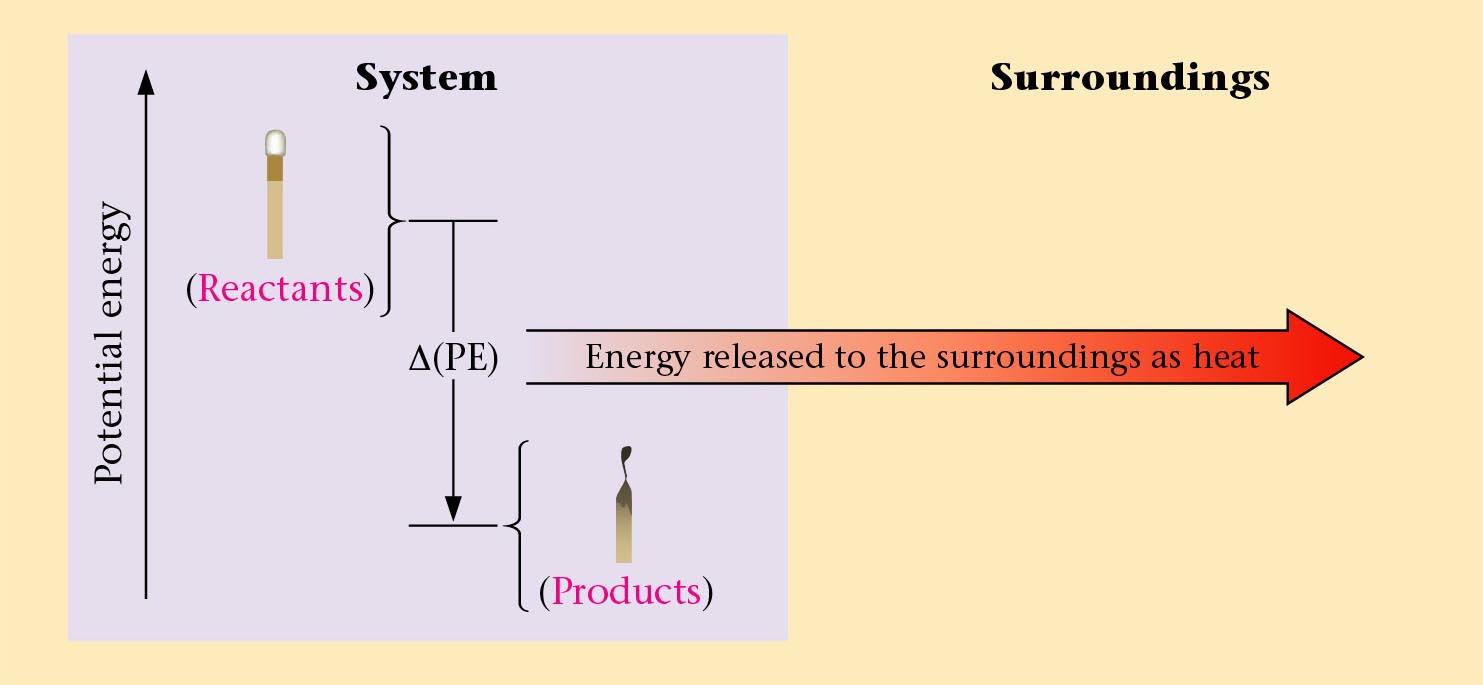
- According to chemistry/physics, when studying reactions etc… the universe is divided into 2 parts:
- The System: the part of the universe which you focus your attention.
- The Surroundings: everything else in the universe.
|
|
16
|
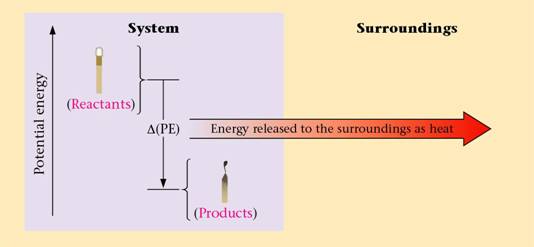
- Energy is lost to the surroundings as heat
- What examples can you think of?
- Think of it in terms of motion of particles
|
|
17
|
|
|
18
|
- Energy is absorbed from the surroundings
- What examples can you think of?
- Consider this: If a chemical reaction gives off heat is it endothermic
or exothermic?
|
|
19
|
- Are the following examples of endothermic reactions or exothermic?
- Water freezing
- Ice melting
- Methane burning
- Water boiling
|
|
20
|
- Thermodynamics: The study of energy.
- The Law of conservation of energy is also called the First Law of
Thermodynamics: The energy of the universe is constant
|
|
21
|
- When we study the heat involved in physical and chemical changes there
will be two important factors:
- Amount of heat involved (number)
- Direction of heat flow (sign)
- Endothermic change - heat absorbed from the surroundings (q = +)
- Exothermic change - heat released to the surroundings (q = -)
|
|
22
|
- DE = q + w
- where E is the amount of energy
- q represents heat
- w represents work
|
|
23
|
- Thermal energy isn't measurable, but heat is.
- Measuring Heat involves these units. Calorie and Joule
- Calorie: the amount of energy
required to raise the temperature of one gram of water one degree
Celsius.
- calorie and Calorie are different. Calorie = 1000 calories. As on food
labels
|
|
24
|
- Joule can be converted to calories
- 1 calorie = 4.184 joules
- convert 60.1 cal into joules 251J
- convert 34.8 cal into joules 146J
- convert 47.3J into cal 11
|
|
25
|
- 1. Mass of object
- 2. Temperature change of object
- Final temperature minus initial temperature
- If there is no change in temperature, no heat flows
|
|
26
|
- 3. Composition of object
- Specific heat: energy required to raise the temperature of 1 g of
material by 1 Celsius
- Every substance has a specific heat that is unique to itself. The
specific heat of water, for example, is 4186 J/ kg x °C (see table on
page 297)
|
|
27
|
- Specific Heat Capacity is used to calculate temperature changes when a
substance is heated
Q = m ▪ Cp ▪
ΔT- Q or q = Heat Energy in Joules
m = mass in kilograms
ΔT = change in temperature (Celsius)
Cp or s = specific heat unit: joule/
kg x C
|
|
28
|
- Example: How much heat energy is absorbed when 88.0 grams of water is
heated from 5.00 degrees Celsius to 37.0 degrees Celsius? ( c-H2O
= 4186 J/ kg x C)
Take inventory first:
m = 0.0880 kg ( you must divide by 1000 to convert to kilograms)
c = 4186 J / kg x C
ΔT = 32 degrees
Celsius ( 37 - 5 = 32)
Q = ?
- Q = ( 0.0880)( 4186)(32)
- Q = 1.18 x 10⁴ J
|
|
29
|
- 100.0 g of water-cools from 30.10°C to 25.05 °C. How much heat is
released?
- 100.0 g of water at 25.00 °C absorbs 100 J of heat. What is its final
temperature?
- A stone weighing 2.0 g absorbs 5.0 J of heat and warms by 3.0 °C. What
is the specific heat of the stone? What is the heat capacity of the
stone?
|

 Notes
Notes